Understanding Stress
Most people talk about stress as if it is something negative that happens to them. Something external. Something harmful. Something that needs to be eliminated. But when people say they feel “stressed”, what they are really doing is putting a label on how something feels. That label is not the definition.
Stress itself is neither good nor bad.
Stress is simply demand.
Stress is Demand
Stress is the result of everything in life that requires your time, energy or attention. Some of those demands are obvious. Work deadlines, financial responsibilities, family commitments, and the things you have promised to do. Other demands are quieter but just as real. Your body maintaining itself. Keeping a roof over your head. Making sure there is food in the fridge. Managing relationships. Thinking about the future.
Even when life feels calm, those demands still exist in the background. They are part of simply being alive.
And without them, nothing would happen.
Demand is what gets you out of bed in the morning. It is what motivates you to solve problems, meet commitments and move forward with the things that matter to you. Without demand there would be no reason to act.
Why Stress Is Not the Enemy
Because stress is simply demand, it is not inherently negative. A certain level of demand is necessary for life to function. It helps us focus, make decisions and prioritise what needs to be done. Think about the difference between a task that matters and one that does not: The task that carries some consequence or importance is the one that usually gets completed first.
That sense of importance is demand. Without it, many things would simply drift down the list and quietly disappear. Demand is what creates movement. It is what drives prioritisation and motivates us to act. For some people the motivation comes from wanting to avoid consequences. For others it comes from the satisfaction of achieving something meaningful.
Either way, demand is the force that moves things forward.
The Part People Often Miss: Capacity
Demand on its own is not the problem. The difficulty appears when demand begins to exceed capacity. Capacity is simply the amount of physical, mental and emotional energy you have available to meet the demands of life. When capacity is healthy, most demands feel manageable. You deal with problems as they arise, work through your responsibilities and continue moving forward. But when capacity drops, the same demands can suddenly feel very different.
The to-do list may not have changed.
Your resources have.
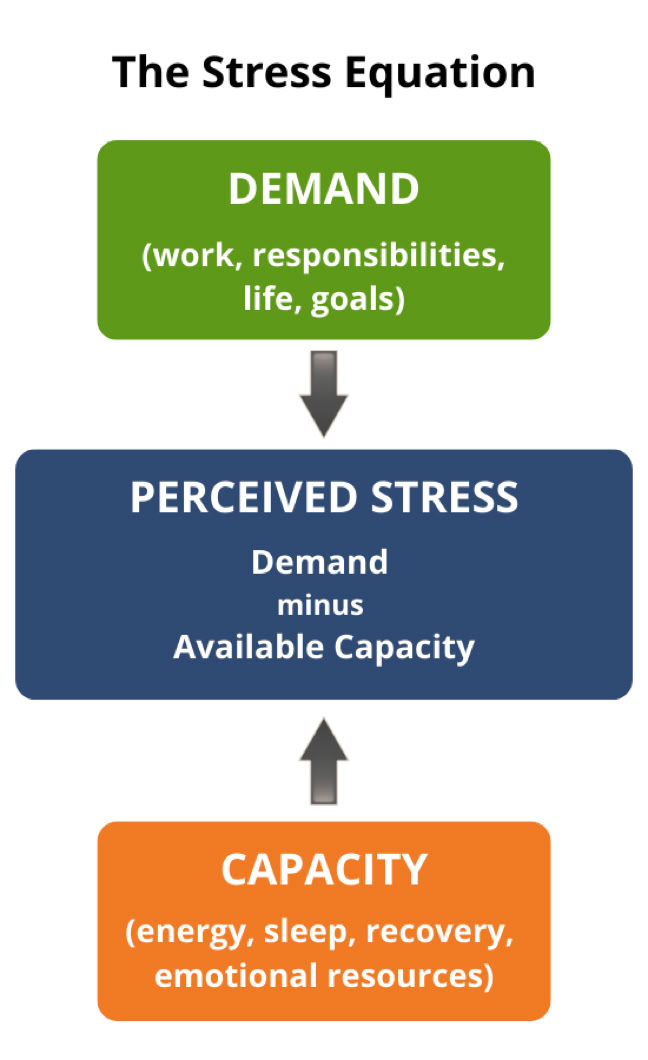
The Stress Equation
A simple way to think about this is:
Perceived stress = demand – available capacity
When capacity is high, the demands of life feel manageable.
When capacity is low, the same demands can feel overwhelming.
This is why the same situation can feel completely different depending on the day.
On a good day, when you are rested and resourced, a full schedule might feel energising.
You work through tasks efficiently and feel on top of things.
On another day, when you are tired or emotionally drained, that same schedule can feel impossible.
The demands did not change.
Your capacity did.
What Reduces Capacity
Capacity is not fixed. It fluctuates depending on what is happening in your life and how well your system is recovering.
Poor sleep gradually reduces physical and mental energy.
Emotional strain such as grief, anxiety or unresolved experiences quietly uses up resources.
Prolonged pressure without adequate recovery slowly depletes reserves.
Illness diverts energy towards healing.
And when recovery does not happen regularly enough, capacity begins to erode.
When that happens, even ordinary demands can start to feel overwhelming.
Not because life suddenly became more difficult, but because you are trying to meet the same demands with fewer available resources.
When the System Stays Overloaded
When demand exceeds capacity for a short period most people can recover. The body and mind are designed to handle periods of pressure provided there is time afterwards to rest and restore.
The difficulty arises when the imbalance continues for weeks, months or sometimes years. When demand consistently exceeds available capacity the system gradually begins adapting in order to keep functioning despite the overload.
This is the point where many people begin to describe themselves as stressed.
Later this month I will be publishing a separate article exploring what happens when this imbalance continues for too long and the system begins to operate in what we call chronic stress.
The Goal Is Not Eliminating Stress
Because stress is simply demand, removing it entirely is neither possible nor desirable. Demand is part of life. It creates movement, responsibility and purpose.
The real aim is balance.
Reducing unnecessary demands where possible.
Restoring capacity where it has been depleted.
And allowing enough recovery so the system can reset before overload becomes the norm.
When demand and capacity are in balance, life may still feel busy, but it feels manageable rather than overwhelming.
The question therefore is not how to eliminate stress from life.
A better question is this.
How do you maintain enough capacity to meet the demands of the life you want to live?